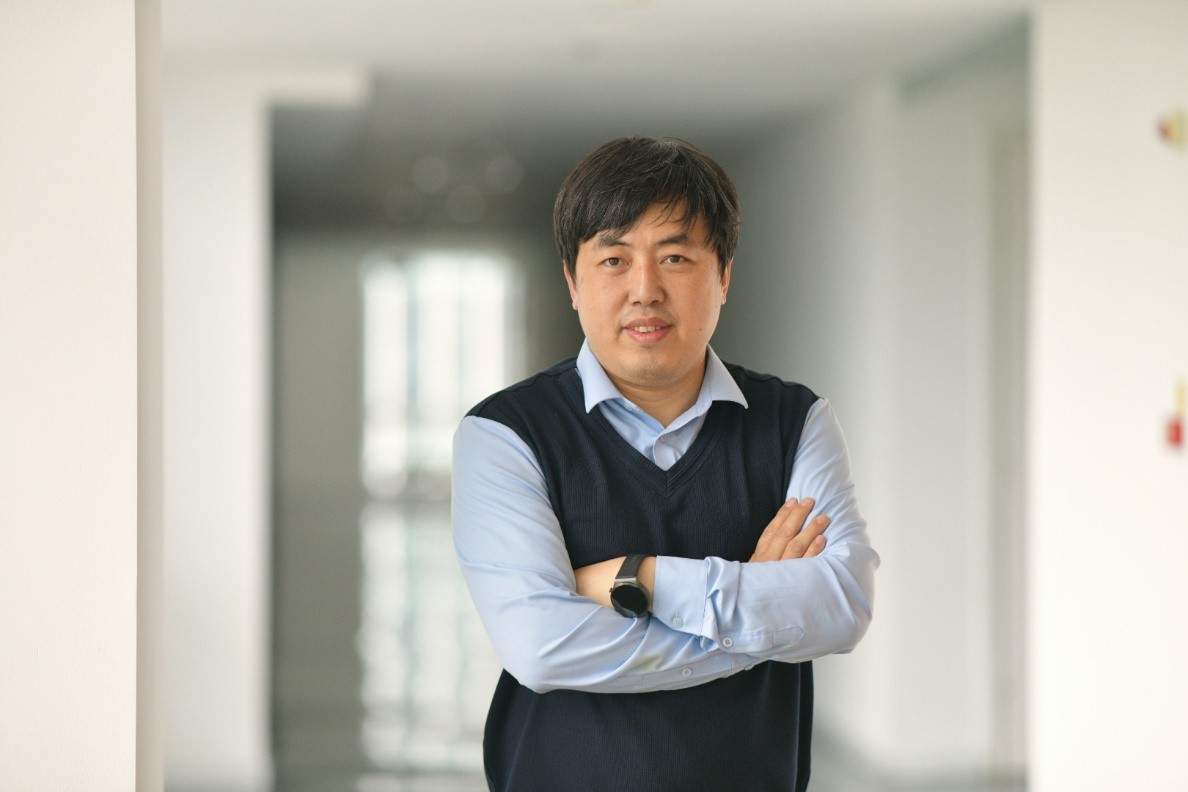
Yulong LI
Email: yulong(at)gmail(dot)com;
Research Area:
The human brain consists of billions of neurons, which connected to form networks by trillions of synapses. The interplay between distinct neuronal types through synapses by long range projections and short range local connections leads to cognitive brain functions such as perception, decision making and motor control.
The biggest challenge to study brain is its complexity. Our lab's research centers on "synapse", the fundamental unit for the communication between brain cells, called neurons. We carry two layers of research: first, we develop cutting edge research tools, namely advanced imaging probes, to untangle the complexity of nervous system in space and in time; second, capitalizing on the advancement of research toolkits, we study the regulation of synaptic transmission, focusing on the modulation of presynaptic transmitter release in health (e.g. sleep) and in disease conditions (e.g. neurodegenerative disease). Specifically, for tool development, we focus on:
1, Development of non-invasive systems for opto-genetic mapping of electric synapses, a basic connection type between neurons. The malfunction of electric synapses could lead to devastating diseases such as deaf, heart problems, epilepsy and brain tumors.
2, Development of genetically-encoded sensors for imaging neurotransmitters/modulators. Those transmitters or modulators are crucial mediators for chemical synaptic transmission, important for our perception, learning/memory and our emotion.
Taking advantage of the above imaging sensors and additional, our functional studies are concentrating on:
1, Exploration, identification and characterization of potential novel small molecule transmitters by a combination of bioinformatics, analytical chemistry, biochemistry, physiology and imaging approaches.
2, Proteomic mapping of the Large Dense Core Vesicles (LDCV), an important yet poor characterized secretory organelle in neurons. The peptide release from LDCV is critically modulating the brain states, such as food foraging, aggression behavior and circadian rhythm.
3, Matching the above novel chemical transmitters/ modulators with their cognate receptors: deorphanization of orphan receptors.
4, Combined 2-photon imaging and genetically-encoded probes, studying how high brain centers are controlled during perception (olfaction) or sleep using fly and mice as model systems.
Selected Publications:
1. Zheng, Y.#, Cai, R.#, Wang, K., Zhang, W., Zhuo, Y., Dong, H., Zhang, Y., Wang, Y., Deng, F., Ji, E., Cui, Y. Fang, S., Zhang, X., Huang, H., Zhang K., Wang J., Li, G., Miao, X., Wang, Z., Yang, Y., Li, S., Grimm, J., Johnsson, K., Schreiter, E., Lavis, L., Chen, Z., Mu, Y., & Li, Y.* (2025). In vivo multiplex imaging of dynamic neurochemical networks with designed far-red dopamine sensors. Science 388, eadt7705.
2. K. Touhara*, K., D. Rossen, D., Deng, F., Castro, J., M. Harrington. A., Chu, T., Garcia-Caraballo, S., Brizuela, M., O'Donnell, T., Xu, J., Cil, O., M. Brierley, S.*, Li, Y.*, & Julius, D.* (2025). Topological segregation of stress sensors along the gut crypt-villus axis. Nature 640, 732–742.
3. Yang J.#, Zhao, T.#, Fan, J.#, Zou, H.#, Lan, G., Guo, F., Shi, Y., Ke, H., Yu, H., Yue, Z., Wang, X., Bai Y., Li, S., Liu, Y., Wang, X., Chen, Y., Li, Y.*, & Lei, X.* (2024). Structure-guided discovery of bile acid derivatives for treating liver diseases without causing itch. Cell. 187(25): 7164-7182. e18.
4. Deng, F.#, Wan, J.#, Li, G., Dong, H., Xia, X., Wang, Y., Li, X., Zhuang, C., Zheng, Y., Liu, L., Yan, Y., Feng, J., Zhao, Y., Xie, H., & Li, Y.* (2024). Improved green and red GRAB sensors for monitoring spatiotemporal serotonin release in vivo. Nature Methods. 21(4): 692-702.
5. Zhuo, Y.#, Luo, B.#, Yi, X., Dong, H., Miao, X., Wan, J., Williams, J. T., Campbell, M. G., Cai, R., Qian, T., Li, F., Weber, S. J., Wang, L., Li, B., Wei, Y., Li, G., Wang, H., Zheng, Y., Zhao, Y., Wolf, M. E., Zhu, Y., Watabe-Uchida, M., & Li, Y.* (2024). Improved green and red GRAB sensors for monitoring dopaminergic activity in vivo. Nature Methods. 21(4): 680-691.
6. Wang, H.#, Qian, T.#, Zhao, Y., Zhuo, Y., Wu, C., Osakada, T., Chen, P., Chen, Z., Ren, H., Yan, Y., Geng, L., Fu, S., Mei, L., Li, G., Wu, L., Jiang, Y., Qian, W., Zhang, L., Peng, W., Xu, M., Hu, J., Jiang, M., Chen, L., Tang, C., Zhu, Y., Lin, D., Zhou, J.-N., & Li, Y.* (2023). A tool kit of highly selective and sensitive genetically encoded neuropeptide sensors. Science. 382(6672): eabq8173.
7. Qian, T.#, Wang, H.#, Wang, P.#, Geng, L., Mei, L., Osakada, T., Wang, L., Tang, Y., Kania, A., Grinevich, V., Stoop, R., Lin, D., Luo, M., & Li, Y.* (2023). A genetically encoded sensor measures temporal oxytocin release from different neuronal compartments. Nature Biotechnology. 41(7): 944-957.
8. Dong, A., He, K., Dudok, B., Farrell, J. S., Guan, W., Liput, D. J., Puhl, H. L., Cai, R., Wang, H., Duan, J., Albarran, E., Ding, J., Lovinger, D. M., Li, B., Soltesz, I., & Li, Y.* (2021). A fluorescent sensor for spatiotemporally resolved imaging of endocannabinoid dynamics in vivo. Nature Biotechnology. 40(5): 787-798.
9. Sun, F.#, Zeng, J.#, Jing, M.#, Zhou, J., Feng, J., Owen, S., Luo, Y., Li, F., Wang, H., Yamaguchi, T., Yong, Z., Gao, Y., Peng, W., Wang, L., Zhang, S., Du, J., Lin, D., Xu, M., Kreitzer, A. C., Cui, G. & Li, Y.* (2018). A genetically-encoded fluorescent sensor enables rapid and specific detection of dopamine in flies, fish, and mice. Cell. 174(2): 481-496. e19.
10. Jing, M.#, Zhang, P.#, Wang, G., Feng, J., Mesik, L., Zeng, J., Jiang, H., Wang, S., Looby, J. C., Guagliardo, N. A., Langma, L. W., Lu, J., Zuo, Y., Talmage, D. A., Role, L. W., Barrett, P. Q., Zhang, L. I., Luo, M., Song, Y., Zhu, JJ* & Li, Y.* (2018). A genetically-encoded fluorescent acetylcholine indicator for in vitro and in vivo studies. Nature Biotechnology. 2018, 36(8): 726-737.